


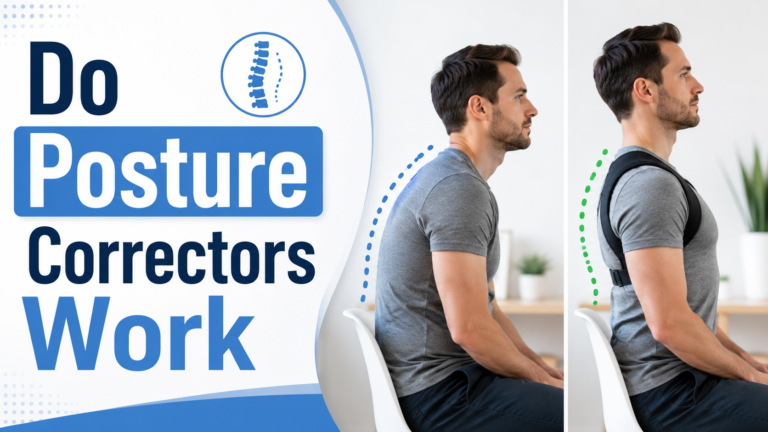

If you’re dealing with back pain, rounded shoulders, or poor posture from hours at a desk, you’ve probably wondered: do posture correctors actually work? With thousands of products flooding the market and conflicting opinions online, it’s hard to separate fact from fiction.
The short answer: Yes, posture correctors can work—but only when used correctly and as part of a broader approach to posture improvement. They’re not a magic fix, but they can be an effective tool when combined with strengthening exercises and ergonomic adjustments.
Let’s dive into what the research says, when they work best, and how to use them effectively.
What Are Posture Correctors and How Do They Work?
Posture correctors are wearable devices designed to pull your shoulders back and align your spine. They typically come in three main types:
-
Shoulder braces – Cross-back straps that pull shoulders into proper alignment
-
Back braces – Full-back support with adjustable straps for lumbar and thoracic support
-
Smart posture trainers – Electronic devices that vibrate when you slouch
The theory is simple: by physically restricting slouching and providing proprioceptive feedback (awareness of body position), these devices help retrain your muscle memory over time.
The Scientific Evidence: What Research Shows
Multiple studies have examined posture corrector effectiveness, and the results are cautiously optimistic:
Short-term improvements are real. A 2019 study in the Journal of Physical Therapy Science found that participants wearing posture correctors for 2-4 weeks showed measurable improvements in forward head posture and shoulder alignment. The devices provided immediate mechanical support that reduced strain on neck and upper back muscles.
Muscle memory can develop. Research from the American Journal of Occupational Therapy suggests that consistent use (2-3 hours daily for 4-6 weeks) helps build postural awareness. Users become more conscious of slouching even when not wearing the device.
They work best with exercise. A 2020 systematic review concluded that posture correctors are most effective when combined with strengthening exercises for the core, back extensors, and scapular stabilizers. The device provides external support while exercises build the internal strength needed for long-term posture improvement.
Not a standalone solution. The same research emphasizes that relying solely on a brace without addressing underlying muscle weakness or ergonomic issues provides only temporary relief.
When Do Posture Correctors Work Best?
Posture correctors are most effective in these scenarios:
1. Mild to Moderate Postural Issues
If you have forward head posture, rounded shoulders, or upper crossed syndrome from desk work, a posture corrector can provide meaningful support. They’re less effective for severe spinal conditions like kyphosis or scoliosis, which require medical intervention.
2. As a Training Tool (Not a Permanent Crutch)
Think of posture correctors as training wheels. Wear them for 30 minutes to 2 hours daily during activities that worsen your posture—desk work, phone use, watching TV. The goal is to build awareness and muscle memory, not permanent dependence.
3. During Recovery from Injury
After shoulder, neck, or upper back injuries, posture correctors can provide support during the healing process. Always consult a physical therapist or doctor for injury-related use.
4. For Office Workers and Remote Professionals
If you spend 6+ hours daily at a computer, a posture corrector can counteract the forward head and rounded shoulder position that screen time creates. Use it during your work sessions, then remove it to allow your muscles to work independently.
When Posture Correctors Don’t Work
Be realistic about limitations:
They won’t fix underlying weakness. If your core and back muscles are weak, a brace provides external support but doesn’t build the strength you need for long-term posture improvement. You must combine them with targeted exercises.
Overuse can backfire. Wearing a posture corrector all day, every day can cause muscle atrophy—your muscles become dependent on the device and weaken further. Limit use to 2-3 hours daily.
They won’t solve ergonomic problems. If your desk setup is poor (monitor too low, chair unsupportive, keyboard position wrong), a posture corrector is a band-aid. Fix your workspace first.
Results aren’t instant. Most users notice improvements after 2-4 weeks of consistent use. Don’t expect overnight changes.
How to Use a Posture Corrector Effectively
Follow these guidelines for best results:
-
Start gradually – Wear for 15-30 minutes daily for the first week, then increase to 1-2 hours
-
Combine with exercises – Do daily posture strengthening exercises (rows, chin tucks, planks, shoulder blade squeezes)
-
Check proper fit – The device should feel snug but not painful; shoulders should be pulled back comfortably
-
Use during high-risk activities – Wear while working at a desk, using your phone, or during activities that trigger slouching
-
Take breaks – Remove the corrector for at least 22 hours per day to allow muscles to work independently
-
Fix your environment – Adjust your workspace ergonomics: monitor at eye level, feet flat on floor, chair with lumbar support
Alternative and Complementary Approaches
For maximum effectiveness, combine posture correctors with:
Strengthening exercises:
-
Rows and reverse flies (strengthen upper back)
-
Planks and bird dogs (build core stability)
-
Chin tucks and neck retraction exercises (counteract forward head posture)
-
Wall angels and scapular squeezes (improve shoulder blade control)
Ergonomic improvements:
-
Raise your monitor to eye level
-
Use a standing desk or sit-stand converter
-
Invest in a supportive office chair
-
Position keyboard and mouse to keep elbows at 90 degrees
Lifestyle habits:
-
Take 5-minute movement breaks every hour
-
Practice the “20-20-20 rule” for screen time (every 20 minutes, look at something 20 feet away for 20 seconds)
-
Strengthen hip flexors and hamstrings (tight lower body muscles contribute to poor posture)
-
Consider yoga or Pilates for full-body postural awareness
Real User Experiences: What People Report
User reviews across thousands of posture corrector purchases reveal consistent patterns:
Positive outcomes (when used correctly):
-
Increased awareness of slouching habits
-
Reduced upper back and neck pain after 2-4 weeks
-
Improved confidence from standing straighter
-
Helpful reminder during long work sessions
Common complaints (when misused):
-
Discomfort from wearing too long initially
-
Muscle soreness (actually a positive sign muscles are activating)
-
No results when worn inconsistently or without exercise
-
Difficulty finding the right size or fit
The key differentiator between satisfied and disappointed users? Consistency and realistic expectations. Those who combined the device with exercise and used it as directed saw results; those expecting a miracle cure did not.
Bottom Line: Do Posture Correctors Work?
Yes—with important caveats. Posture correctors are effective tools for improving posture when:
✅ Used consistently (daily for 2-4 weeks minimum)
✅ Combined with strengthening exercises
✅ Worn for limited periods (1-3 hours daily, not all day)
✅ Paired with ergonomic workspace improvements
✅ Used to build awareness, not as a permanent solution
They’re not effective when:
❌ Used alone without exercise or ergonomic changes
❌ Worn all day (causing muscle dependency)
❌ Expected to provide instant results
❌ Used to treat severe spinal conditions without medical guidance
If you’re serious about improving your posture, a posture corrector can be a valuable part of your toolkit—but it’s just one piece of the puzzle. Commit to the exercises, fix your workspace, and use the device as a training aid, and you’ll see real, lasting improvements.
Ready to Improve Your Posture?
If you decide a posture corrector is right for you, look for these features:
-
Adjustable straps for a customized fit
-
Breathable materials to prevent skin irritation during extended wear
-
Figure-8 or X-back design for effective shoulder retraction
-
Discreet profile that can be worn under clothing
-
Positive user reviews mentioning comfort and effectiveness
Remember: the best posture corrector is the one you’ll actually wear consistently—combined with exercises and ergonomic improvements that address the root causes of your posture problems.
Your back will thank you. Interested to Buy click here: https://mojitofashion.com/adjustable-posture-corrector-back-support-belt-for-men-women/
Disclaimer: This article is for informational purposes only and does not constitute medical advice. Consult a healthcare professional or physical therapist before starting any new treatment for back pain or postural issues, especially if you have existing medical conditions.




0 Comments