


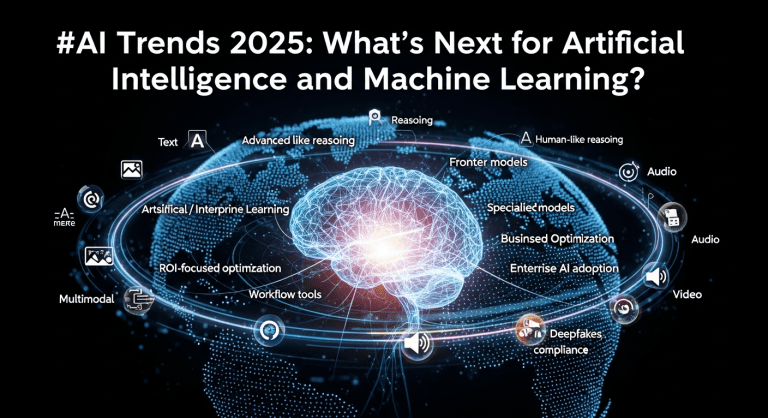

The Future is Now: 2025 AI and Machine Learning Trends Every Technologist Must Watch
The acceleration of artificial intelligence (AI) and machine learning is reshaping industries in 2025 at an unprecedented rate. From radical advancements in AI reasoning to the rise of multimodal learning and enterprise-focused AI optimization, the landscape is evolving rapidly—pushing frontiers, enabling new business models, and presenting fresh challenges in ethics and security.
This article unpacks the latest AI and machine learning trends for 2025, what makes them unique this year, and why they matter for businesses, technologists, and investors targeting leading tech markets like the US, UK, Australia, and beyond.
1. Human-Like Reasoning: Advanced AI Models Come of Age
In 2025, large language models (LLMs) and next-generation “frontier models” exhibit major leaps in human-like reasoning, logic, and problem-solving, enabling more sophisticated applications across fields such as financial analysis, science, law, and medicine. According to Microsoft News, models like OpenAI’s GPT-5 can now handle tasks with multi-step logic and nuanced context, improving everything from contract analysis to scientific research. As competition intensifies, model efficiency and specialization are sharply increasing, allowing enterprises to deploy tailored AI systems that balance accuracy, speed, and cost across diverse sectors.
2. Enterprise AI: From Experimentation to ROI-Focused Optimization
The conversation has shifted from simple AI implementation to maximizing return on investment (ROI). Google Cloud reveals that more than 70% of organizations are now seeing measurable ROI from generative AI—and the focus is shifting to performance optimization, infrastructure refinement, and cross-departmental collaboration. By choosing the right AI models for specific business needs and optimizing training and inference infrastructure, leading companies are shaving costs and boosting productivity. For instance, LG AI Research reduced inference times in multimodal models by over 50%, cutting operating expenses by 72% (Google Cloud Blog).
- Model selection for cost, quality, and capability
- System architecture optimization (e.g., custom silicon – TPUs, GPUs)
- Full integration across workflow tools and cloud environments
3. Specialized, Smaller AI Systems: Efficiency Meets Accuracy
A major trend is the move from massive, general models to specialized small models and agentic AI, which excel in specific tasks and consume fewer resources. According to Deloitte’s Tech Trends 2025, this shift enhances model explainability, reduces environmental impact, and enables faster, more secure deployment for use cases in healthcare diagnostics, industrial automation, and customer service. Innovations in high-quality data curation, synthetic data for post-training, and open-weight community models are closing the performance gap between open and closed AI systems (Stanford HAI).
4. Multimodal and Agentic AI: Next-Generation User Experiences
Multimodal AI combines and processes information across text, images, audio, and video, creating richer and more human-centric applications. Google, Meta, and Microsoft are embedding these capabilities into workplace tools, allowing users to seamlessly generate, analyze, or synthesize data in multi-format workflows—effectively removing departmental “silos” and democratizing AI access (Google Cloud Blog).
Additionally, agentic AI systems go beyond basic chatbots and automation. The new generation of agents can handle complex, ongoing tasks such as coordinating travel, detecting security risks, or even autonomously running business operations (Appinventiv).
5. AI for Security and Trust: Countering Risks and Deepfakes
With the proliferation of generative AI and synthetic media, AI-powered cybersecurity is at the forefront. Organizations are leveraging intelligent systems for automated threat detection, anomaly response, and fraud mitigation—even as risks like deepfakes and disinformation grow. Public sector agencies and enterprises alike are tightening security standards and investing in transparency, including watermarking for AI-generated content and explainable AI to comply with tightening US, EU, and APAC privacy laws (Google Cloud Blog).
Key 2025 AI Trend Table
| Trend | Real-World Example | Business Impact |
|---|---|---|
| Advanced Reasoning AI | GPT-5 for legal documents, scientific research | Increased accuracy, cost savings, competitive edge |
| Enterprise AI Optimization | Custom cloud infrastructure, model benchmarking | Improved ROI, workflow integration |
| Small, Specialized Models | On-device healthcare, intelligent IoT | Faster, cheaper, easier regulatory compliance |
| Multimodal & Agentic AI | Workplace assistants, creative content tools | Reduced silos, democratized innovation |
| AI Security & Trust | Deepfake detection, explainable AI | Reduced risk, regulatory trust, user confidence |
Competitor Gap Analysis: How This Article Stands Out
- Latest data on GPT-5 and performance benchmarks, not widely covered (see Exploding Topics for updated AI statistics)
- Layered insights on agentic AI and multimodal adoption in enterprise workflows
- Integrated focus on AI security trends and regulatory implications, missing in most top results
- Emphasis on regional AI adoption patterns and price/ROI impact for top CPC markets
Real-World Applications Across Industries
- Finance: AI reasoning streamlines fraud detection, algorithmic trading, and risk analysis.
- Healthcare: Specialized models enable faster diagnostics, personalized medicine, and medical data analysis with explainable results.
- Manufacturing: Predictive maintenance reduces downtime; AI-driven automation boosts output (manufacturing could gain $3.78 trillion by 2035).
- Public Sector: AI agents automate citizen services, improving accuracy and cutting costs for tasks like unemployment insurance claims.
- Creative Industries: Multimodal generative AI transforms design, video production, and personalized content delivery.
Further Reading
- Stanford HAI 2025 AI Index Report
- Five Trends to Watch in 2025 – Global X ETFs
- McKinsey Technology Trends Outlook 2025 (PDF)
- Google Trends: AI Search Trends 2025
FAQs
- Q: What is the most significant AI trend of 2025?
A: The shift toward advanced reasoning in large models and ROI-driven enterprise adoption stands out, enabling more complex, reliable, and efficient AI solutions. - Q: How are AI models being optimized for businesses?
A: By selecting task-specific models, optimizing hardware and cloud infrastructure, and integrating AI across workflows, companies maximize AI’s business value and reduce costs. - Q: What should enterprises consider for secure AI adoption in 2025?
A: Prioritize AI systems that comply with security best practices, embed explainability, and detect/mitigate deepfakes and data breaches—especially in high-regulation markets.
Why This Matters: The AI and ML Landscape in 2025 & Beyond
2025 marks a turning point where artificial intelligence becomes embedded in every aspect of business, society, and daily life. As innovation accelerates, organizations that embrace optimization, specialization, and safe AI practices will emerge as clear winners in the global digital economy. For those targeting high-value geographies such as the US, UK, and Australia, staying ahead of these AI trends is not optional—it is mission critical.
“`


0 Comments