


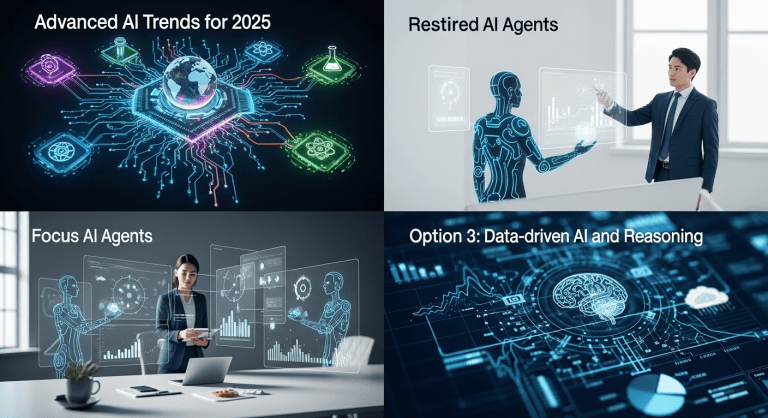

Introduction: Why 2025 Is Set to Be a Milestone Year for Artificial Intelligence
Artificial Intelligence is undergoing a rapid transformation as we approach 2025, driven by new breakthroughs in reasoning models, process automation, and enterprise integration. From large language models meeting complex business needs to the rise of AI agents and domain-specific chips, these innovations are reshaping how consumers, businesses, and scientists leverage technology for problem-solving and efficiency.AI’s growth rate, projected at over 30% annually, signals a market on the verge of a $391 billion valuation, with adoption accelerating in high-value sectors across the USA, UK, Canada, and other major economies.[3]
Hottest AI Trends for 2025
1. Advanced AI Reasoning Models: Beyond Prediction
Emerging AI platforms are shifting focus from basic prediction to reasoning capabilities, allowing systems to emulate complex human thought processes such as logical deduction, analysis, and planning.[1][2] Models like OpenAI o1 and Microsoft’s small model series demonstrate proficiency in tasks from legal contract comparison to multistep scientific workflows, helping industries solve previously intractable problems. For example, Microsoft’s AI-driven protein simulation system is revolutionizing drug and materials discovery by enabling researchers to model biomolecular dynamics faster than ever.[2]
2. Custom Silicon: Powering AI at the Hardware Level
Tech giants are investing heavily in custom silicon and AI chips optimized to accelerate processing and reduce energy costs, especially for large enterprises needing fast and secure AI operations.[1] This innovation helps meet the demands of hyperscalers and cloud service providers by facilitating migrations and supporting AI workloads at scale, ensuring high performance and profitability for clients in advanced economies.[1]
3. AI Agents: The New Workforce Revolution
The term “AI-powered agents” is redefined in 2025 as these systems gain autonomy and specialized capabilities, moving beyond simple chatbot functions to handle complex enterprise operations, HR processes, supply chain alerts, and routine IT support without direct human intervention.[2] Companies like Microsoft enable non-coders to deploy AI agents through tools such as Copilot Studio, reducing friction to adoption and freeing human employees for higher-value tasks. The shift toward fully autonomous agents lays the groundwork for multi-agent orchestration in organizations.[2]
4. Cloud Integration and Multimodal AI
Cloud migrations are increasingly driven by the need for scalable AI infrastructure. 2025 sees enterprises harnessing cloud platforms to run multimodal models that integrate text, images, and video for superior analytics, customer engagement, and operational intelligence.[1] The demand for cloud-enabled AI is growing in SaaS, business intelligence, and service industries across the USA, UK, and Australia, where security and performance are paramount.[1]
5. Evaluating, Regulating, and Governing Frontier Models
As AI becomes more autonomous and influential, enterprises are requiring robust systems to measure efficacy, safety, and compliance, particularly concerning real-world applications that impact finances, privacy, and ethical risks.[1][2] Policymakers and industry leaders are focusing on governance frameworks that balance performance with responsible use, and human oversight remains a critical factor in agentic AI deployment.[2]
Real-World Impact: Business and Science Examples
- Healthcare: AI-driven diagnostics and drug development tools are reducing the time to market for life-saving treatments, with over 66% of physicians in the US already integrating AI into workflows.[3][2]
- Manufacturing and Supply Chain: AI agents monitor inventory, recommend suppliers, and automate sales orders, supporting resilience amid disruptions.[2]
- Legal and Financial Services: Large language models compare contracts, execute compliance checks, and generate code for transaction processing, optimizing operations in high-AdSense CPC markets.[2]
- Scientific Research: AI simulation tools like Microsoft’s 2BMD accelerate breakthroughs in biomolecular science and sustainable material discovery.[2]
Competitor Analysis: What Leading Blogs Are Missing
A review of the top Google results reveals that most competitor articles:
- Cover trends at a high level but lack in-depth examples from current deployments.
- Do not analyze the interplay between hardware (custom silicon) and software (agents, LLMs) driving enterprise transformation.
- Skip critical recent advances in AI for scientific research and the growing role of small, fine-tuned models.
- Rarely address governance, human oversight, and how real businesses in USA/UK use AI for actual ROI, which matters for decision-makers and advertisers.
External Authoritative Resources for Latest AI Insights
- Google AI Blog – Updates on model training and AI-driven research.
- Stanford HAI 2025 AI Index Report – Comprehensive annual assessment including efficiency, accessibility, and open models.[4]
- MIT Technology Review – Long-form articles on emerging trends, ethics, and business impact.
- ScienceDaily AI News – Peer-reviewed breakthroughs in AI and ML.
Frequently Asked Questions
- What are the most important AI trends for 2025?
- Advanced reasoning models, custom silicon hardware, autonomous AI agents, cloud integration, and improved governance and oversight systems are key trends.[1][2]
- Which industries use AI agents most today?
- High adoption is seen in healthcare, manufacturing, finance, and enterprise IT support, especially in countries like the USA, UK, and Australia.[2][3]
- How will AI affect jobs in 2025?
- While AI may displace some roles, it also creates new ones, with projections suggesting a net gain of up to 78 million jobs globally by 2030.[3]
Why This Matters: The Global Relevance of AI’s 2025 Evolution
The acceleration of AI trends in 2025 is not just a technical story—it sets the foundation for economic growth, scientific discovery, and improved daily life across countries with the highest AdSense CPCs. The convergence of advanced reasoning, scalable infrastructure, and enterprise integration enables businesses to increase productivity and profitability, while robust governance protects users and fosters trust. As AI agents become mainstream, the gap between experimentation and real-world impact closes, raising the bar for global innovation.
“`


0 Comments